
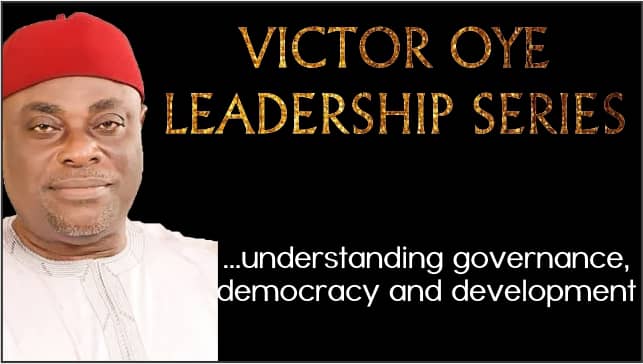
VICTOR OYE: The Triumphs of A Silent Revolutionary
By Collins Opurozor
Nigerians are worried that two decades after a return to democracy, the vaunted dividends that animated the passion for expulsion of the military from politics and the reestablishment of an ostensible democratic order have remained elusive. For far too many, our democracy has failed.
To be sure, the perceived failure of our democracy is not seen more in the flawed electoral system than it is seen in the following antinomies: national wealth now creates poverty for the nationals, affluence breeds affliction and Nigerian security causes insecurity for Nigerians. Since the core essence of the democratic enterprise is to create a system that ensures the greatest happiness of the greatest number of people through popular participation in the decision of who gets what, when and how, Nigerians have no illusion that much is yet to be done about it.
Many factors have therefore been blamed for this democratic deficit. Our cultural plurality and its centrifugal tendencies, tenuous electoral laws, weak regulatory regime, corruption and poverty have very often been said to constitute encumbrances to our democratization process. Indeed, singly or conjointly these elements can have implications on electoral democracy, but they do not constitute the major issue, for a comparative analysis would quickly reveal that nations with similar features as Nigeria have fashioned a better democracy than Nigeria. So, where lies the issue?
The greatest tool for democratic consolidation and national cohesion is the political party. It is the failure to grasp this broader engagement of the political party that often leads to the erroneous assumption that the main – almost the sole – aim of political parties is to win elections. This is not correct. The vigour of democracy is dependent on the political party, and wherever and whenever the party fails to set the tune of politics and define its norms, everything evil becomes acceptable in politics. So political parties first owe the system a duty to sustain democracy, cause elected leaders to deliver value, train intending leaders in democratic best practices and become the bastion for good governance.
It is clear, from the foregoing, that Nigerians have not been sufficiently attentive to what happens within the political parties and the implications the intra-party dynamics on the country’s democracy and development. An attempt to understand this is in order here, and this is where Dr. Victor Oye (Ozonkpu), APGA’s National Chairman, stands out.
Between 1923 when Herbert Macaulay founded the very first political party in Nigeria, NNDP, and today, the party system in Nigeria has almost always been plagued by the erosion of internal democracy. The multiplier effects of this further spill over into the larger political spectrum and manifest as the multifarious crises that have defiled our democracy.
Standard bearers of political parties emerge through a set of hollow rituals known as primaries, and so such must be replicated at the main elections, since ab initio these are not popular choices. Membership of political parties therefore carries no meaning in the face of the withdrawal of the right to nominate candidates from party members. This was the main ill that suffocated APGA until 2015 when Dr. Victor Oye took over as the party’s helmsman. First, there was a sustained effort by Dr. Oye to expand the democratic space within the party by energising the structures and reconstructing its delegates for primaries into sets and increasing the overall number in each ward from three to fifteen. In this way, more members have been enfranchised and the outcomes of primaries become better reflections of the wishes of the party faithful.
Second, the accountability deficiency that has been the bane of our democracy is one malaise that the leadership of Dr. Oye has fought to a standstill in APGA. Nigerians were thrown into disbelief that for the first time in the history of the country a political party would conclude primary elections and emerge from general elections and go public to declare its income and expenditure with mathematical precision. This is democracy in practice, and this is what Dr. Oye has brought to Nigeria’s party system.
Third, the menace of a few wealthy kingpins calling the shots within the political parties often alienates the party from its members and undermines its democratic aspirations. Yet again, Dr. Victor Oye has built strong instructions within APGA to check against the this. He has further built APGA into a financially stable party, the only political party in the history of Nigeria to have built its own National Secretariat in Abuja. While every other party is a tenant in Abuja, APGA is a landlord. By creating a strong financial base for the party, Dr. Oye has insulated APGA from the caprices of the wealthy few and made it answerable to its members.
It is testimony to the loftiness of Dr.Oye’s vision and index of his political dexterity that APGA now wins elections across Nigeria, including, even in an overwhelming scale, the North.

The last ten months have been a season of harvest of awards, appointments and recognitions for Dr. Victor Oye. A morally astute citadel of learning, Tansian University, had appointed him into their Governing Council. Various groups, secular, political and religious, have also sought to identify with this pioneer member of the prestigious Ozonkpu Title, and have ceaselessly crowned his efforts and drive for reformed politics. Most recently, President Muhammadu Buhari appointed him as a member of the National Steering Committee of the Nigeria Agenda 2050, a lofty initiative that aims at lifting one hundred million Nigerians out of poverty within ten years.
Our democracy will get better when we begin to celebrate those with the vision to change the narrative and the passion to make it happen. Dr. Oye is leading the way in this regard.
©️News Corner.
SHARE WITH YOUR BROTHERS, SISTERS & NEIGHBOURS!!!

Discover more from NEWS CORNER
Subscribe to get the latest posts sent to your email.
Warning: count(): Parameter must be an array or an object that implements Countable in /home/mynewsco/public_html/wp-content/themes/trendyblog-theme/includes/single/post-tags-categories.php on line 7
About author

You might also like
OYE: Confronting Nigeria’s Paradox Of Plenty
Share on WhatsApp By Collins Opurozor. Last Wednesday, President Mohammadu Buhari inaugurated the National Steering Committee for the Preparation of Medium Term Development Plan (2021- 2025) and Nigeria Agenda 2050.
SHARE WITH YOUR BROTHERS, SISTERS & NEIGHBOURS!!!

Victor Oye, Agenda 2050 And Quest For National Development
Share on WhatsApp By Collins Opurozor. Recently, the National Chairman of APGA, Dr. Victor Ike Oye (Ozonkpu), was called up for a national assignment by President Mohammadu Buhari. By President
SHARE WITH YOUR BROTHERS, SISTERS & NEIGHBOURS!!!

OYE, APGA And The Path To Democratic Consolidation
Share on WhatsApp By Collins Opurozor Nigeria’s electoral democracy has often come under scathing attacks especially within the intellectual circles. Sobriquets like simulated landslides, direct captures, hollow rituals, murky waters,
SHARE WITH YOUR BROTHERS, SISTERS & NEIGHBOURS!!!

APGA, Oye And the Naysayers
Share on WhatsApp By Collins Opurozor. Politics means different things to different persons. Some say it is all about who gets what, when and how. Some others believe it is
SHARE WITH YOUR BROTHERS, SISTERS & NEIGHBOURS!!!

Oye, APGA And Nigeria at 60
Share on WhatsApp By Collins Opurozor. Nigeria is now sixty years as an independent nation. But, unarguably, debates about the country’s nationhood still rage on. For many, we cannot but


0 Comments
No Comments Yet!
You can be first to comment this post!