
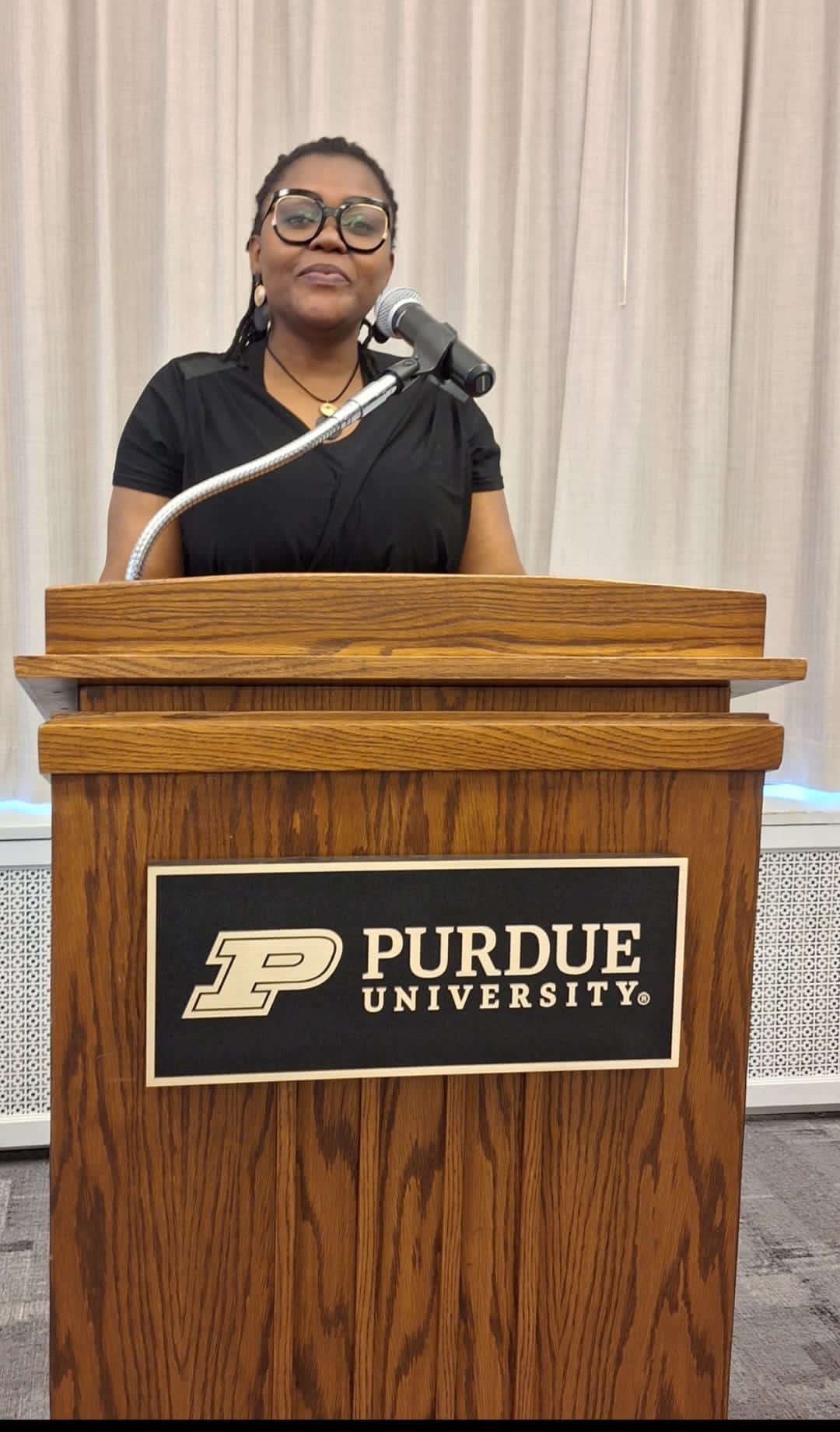
When War Stories Become Scholarship: Chinaza Egere’s Path from Aba to International Genocide Research
Chinaza Justina Egere speaks softly, but her words carry continents. From Aba, Nigeria, to Purdue University in the United States, her journey is one of memory, silence, and global scholarship. Born and raised in Aba, Nigeria, the heart of Igboland, and now pursuing a Ph.D. at Purdue University in the United States, Egere is carving out a name for herself as one of the most promising African scholars of her generation. Her research is bold, intersectional, and urgent: Genocide, migration, memory, and postcolonial trauma.
“All the stories my father told me in childhood were centered on the war,” she recalls.
“The Nigerian-Biafran War and what it meant for the Igbo people. The war had impacted him so negatively that it became the only narrative he could access. That overwhelming focus, and the silence it created around everything else, shaped me. It pushed me to ask the questions about all the other stories that couldn’t emerge from under the weight of that trauma.”
It is from this personal silence that Egere’s intellectual voice has emerged clear, multilingual, and internationally recognized. A third-year doctoral fellow at Purdue’s School of Languages and Cultures and a recipient of the prestigious Ross Fellowship, she studies how literature becomes a vessel for memory, resistance, and healing in post-genocide African contexts. She reads and writes in French, English, Igbo, and German, and is gaining traction across continents for work that bridges the humanities and human rights.
Over the last year, Egere’s star has risen with remarkable speed. In December 2024, she was selected for a prestigious international research trip to Burundi under the Genocide and Human Rights Research in Africa and the Diaspora (GHRAD) initiative. There, she conducted interviews, gathered testimony, and collaborated with survivors and scholars on post-genocide recovery. Her experience in Burundi shaped not just her academic work but also her ethical commitment to survivor-centered storytelling.
“Being in Burundi changed how I approach literary texts. I no longer read only with academic distance. I read with a deeper awareness of the real human experiences behind the narratives.”
In March 2025, she presented a groundbreaking paper, “Resilience Amidst Adversity: Healing and Transformation in Marie-Thérèse Toyi’s Weep Not, Refugee,” at the GHRAD Conference in Chicago, her second presentation at the GHRAD conference. Her analysis explored how storytelling functions as a survival strategy among refugees. She followed this with a paper at the Kentucky Foreign Language Conference titled: La corporalité féminine comme espace de résistance dans La grosse femme d’à côté est enceinte de Michel Tremblay – Women’s Bodies as Spaces of Resistance, examining how women’s bodies become sites of resistance to patriarchal, heteronormative, and social oppression in the works of Michel Tremblay.

Egere is not just a voice in literature; she is becoming a voice in public discourse. In February 2025, she traveled to Germany to present her research at the First International Conference on Contradiction Studies at the University of Bremen, where she explored how African literature navigates paradoxes of identity, belonging, and postcolonial rupture, with a focus on migration. In May, she presented at the prestigious American Comparative Literature Association (ACLA), where she discussed colonial legacies and refugee identity in Gaël Faye’s Jacaranda. She also presented at the African Literature Association (ALA) and the Igbo Studies Association, adding to her growing list of international academic engagements and professional memberships. Egere is an active member of the African Literature Association, the Igbo Studies Association, the American Comparative Literature Association, and the Genocide and Human Rights Research in Africa and the Diaspora (GHRAD).
What makes Egere’s work compelling is its fusion of lived experience with scholarly excellence. As a woman from a community still reckoning with the memory of the Nigerian Civil War, she brings urgency to her analysis of genocide and its aftermath. As an academic, she applies trauma theory, memory studies, feminist thought, and postcolonial criticism with precision to understand how communities survive and recover from systematic violence.
Her leadership extends beyond the page. At Purdue, she serves as a Graduate Teaching Assistant in French, where she supports student learning and facilitates cross-cultural engagement. In April, she organized and moderated a workshop titled Academia and Beyond: Exploring Diverse Career Paths, which brought together alumni now working in academia, policy, and the private sector to mentor current graduate students.
She is also a two-time recipient of both the Purdue Promise Grant and the School of Languages and Cultures Graduate Grant and was honored with Purdue’s 2024 Special Employee Recognition Award. Her record of multiple competitive grants, including the PGSG Research Grant, fellowships, and conference presentations, has earned her wide respect in academic and human rights circles.
Egere has undertaken a focused study in Holocaust, Genocide, and Atrocity Prevention Studies. Fluent in French and Igbo, proficient in German, and rooted in English, she embodies the multilingual consciousness required for transnational work in trauma and memory studies. Her forthcoming dissertation will focus on gendered narratives of genocide and displacement in Burundi. Her approach is grounded in trauma theory, memory studies, postcolonial criticism, and feminist analysis, reading literature as an archive, testimony, and a form of resistance against historical erasure.
As Nigeria, Africa, and the world confront crises of migration, identity, legacies of genocide, and mass violence, Chinaza Egere is among the young scholars helping to light the path forward.
“I study genocide and its aftermath,” she says. “Because I saw firsthand how it shaped my father and my community.”
SHARE WITH YOUR BROTHERS, SISTERS & NEIGHBOURS!!!

Discover more from NEWS CORNER
Subscribe to get the latest posts sent to your email.
About author

You might also like

NYSC: What corps members must avoid during service year – DG
Share on WhatsApp Brig.-Gen. Suleiman Kazaure, the Director-General, National Youth Service Corps (NYSC) has warned corps members to shun unnecessary travels and night parties that may endanger their lives. Kazaure
SHARE WITH YOUR BROTHERS, SISTERS & NEIGHBOURS!!!


NYSC Corps posted to Borno Members Relocated
Share on WhatsApp While speaking at their swearing in programme at the NSDC College in Katsina, Borno State Governor, Kashim Shettima, opened up on the reason why NYSC corps members
SHARE WITH YOUR BROTHERS, SISTERS & NEIGHBOURS!!!


Philanthropist, Barrister Njoku Donates Solar Street Lights To All Traditional Rulers in Mbaise
Share on WhatsApp A philanthropist, Barrister Emma Njoku has procured solar Street lights to be distributed to all the traditional rulers in mbaise, Imo State.Barrister Njoku extended the gesture to
SHARE WITH YOUR BROTHERS, SISTERS & NEIGHBOURS!!!


St. Columba’s Parish, Amaimo Set to Welcome Archbishop Ugorji on Pastoral, Canonical Visit
Share on WhatsApp ThankGod Emeh… Joy and spiritual anticipation fill St. Columba’s Parish as parishioners prepare to host the Archbishop of the Owerri Archdiocese, His Grace, Most Rev Lucius Ugorji
SHARE WITH YOUR BROTHERS, SISTERS & NEIGHBOURS!!!

Okorocha Sues INEC, Says it lacks Moral Justification to Withhold his Certificate of Return
Share on WhatsApp The Governor of Imo state, Rochas Okorocha has sued the Independent National Electoral Commission, INEC to court asking them to urgently present him his certificate of return
SHARE WITH YOUR BROTHERS, SISTERS & NEIGHBOURS!!!


71yrs Old Japanese Man Arrested for ‘making 24,000 complaint calls’
Share on WhatsApp A Japanese pensioner has been arrested after ringing a phone company 24,000 times to complain they had violated his contract, police and local media reported. Tokyo police


0 Comments
No Comments Yet!
You can be first to comment this post!