

What Science Says About Snacking and Breakfast
From OLAYINKA
Cutting back on salt, high fat foods and too many breads and pasta, and eating more fruits and vegetables is the best way to a healthy heart. But eating well isn’t just about what you eat, say heart experts, but about when you eat.
In a new Scientific Statement, experts from various committees of the American Heart Association say that paying attention to how often you eat, and at what time of the day you eat, can help to lower risk of heart attacks and stroke.
The panel reviewed all of the available studies on how often and when people eat. Based on what’s known so far, the panel, led by Marie-Pierre St-Onge, an associate professor of nutritional medicine at Columbia University, supports existing advice about the benefits of breakfast. That advice is based on studies that compare breakfast-eaters to non-eaters and their heart disease events. Breakfast-eaters tend to have lower rates of heart disease, and were also less likely to have high cholesterol, and high blood pressure. They also tended to have more normal blood sugar levels and sugar metabolism, meaning they were at lower risk of diabetes than those who didn’t eat breakfast. Still, the existing research isn’t strong enough yet to say that people who don’t normally eat breakfast should start—or that people who already do should expect to be heart-disease and diabetes-free for the rest of their lives.
The data isn’t so clear on the benefits of eating more frequently during day. While some observational studies that ask people about their meal habits suggest that people who eat more often have lower cholesterol and reduced risk of diabetes, the data is more mixed on whether eating smaller meals more often can help with weight loss. And the controlled studies that more rigorously tracked exactly what people ate found that more frequent eating, even if the total number of calories was kept constant, may not be beneficial for lowering heart disease risk or obesity.
Finally, on the question of what effects eating earlier in the day or later in the day can have on heart health, the panel found that the research points toward the benefits of eating earlier rather than later. More studies are needed but the initial finding makes sense, says St-Onge. The more calories you eat during the day, the more chances you have of burning off those calories.
Plus, there’s growing evidence that the body’s metabolism is different during the day, when the body is active, than during the evening, when it’s preparing to shut down. “The body and all of the organs have clocks,” she says. “There is a timing that provide all the nutrients that organs need, and the timing activity of enzymes and other agents that process food are better earlier in the day than at night.”
So while more research is certainly needed to better understand how the timing and frequency of how meals affect your health, it wouldn’t hurt to keep eating breakfast (if you already do) and try to space your meals earlier in the day
SHARE WITH YOUR BROTHERS, SISTERS & NEIGHBOURS!!!

Discover more from NEWS CORNER
Subscribe to get the latest posts sent to your email.
Warning: count(): Parameter must be an array or an object that implements Countable in /home/mynewsco/public_html/wp-content/themes/trendyblog-theme/includes/single/post-tags-categories.php on line 7
About author

You might also like

COVID-19: Key Symptoms, Difference Between Self-Isolation, Quarantine, Distancing, Must Do and Donts If In Contact With A Positive Patient
Share on WhatsApp There have been several misconceptions about the disease and without knowing the symptoms many persons have been misdiagnosed, leaving them in more danger of dying from the
SHARE WITH YOUR BROTHERS, SISTERS & NEIGHBOURS!!!


Nigeria’s Index Coronavirus Patient Confirmed Negative, Discharged
Share on WhatsApp The Lagos State government has confirmed the discharge of Nigeria’s index Coronavirus patient. The patient, who is an Italian, has been receiving treatment at the Infectious Disease
SHARE WITH YOUR BROTHERS, SISTERS & NEIGHBOURS!!!

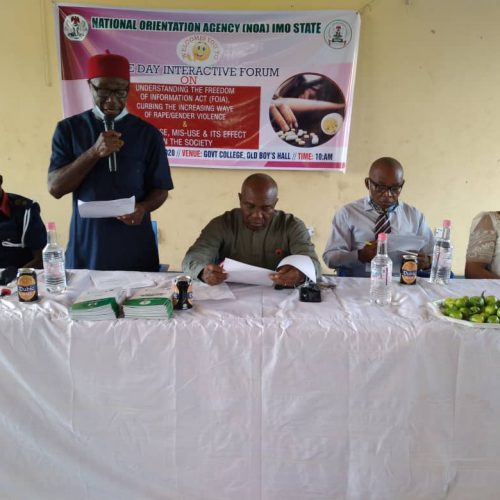
NOA Sensitises Public on FOI Act, Rape, Drug Abuse in Imo
Share on WhatsApp The National Orientation Agency (NOA) has harped on the need for people to understand and apply the Freedom of Information Act (FOIA) to curb the rate of
SHARE WITH YOUR BROTHERS, SISTERS & NEIGHBOURS!!!


World Menstrual Hygiene Day: Foundation distributes 10,000 sanitary pads to students in Imo
Share on WhatsApp The Ike Odoeme Foundation, a Non Governmental Organisation (NGO), has distributed 10,000 sanitary pads to students in Imo, to mark the 2024 World Menstrual Hygiene Day. Our
SHARE WITH YOUR BROTHERS, SISTERS & NEIGHBOURS!!!


ICON Student Nurses Refute Alleged N400,000 Fee By Imo Education Commissioner
Share on WhatsApp Student Nurses of Imo State College of Nursing Sciences Orlu ( ICON) have described the alleged #400,000 per session fee against the College management as reported in
SHARE WITH YOUR BROTHERS, SISTERS & NEIGHBOURS!!!


120 Imo health workers trained on adolescent, youth friendly health services
Share on WhatsApp By Chigozie Uzosike For many young people, visiting a health facility can be intimidating, often shaped by fear of judgment, lack of privacy, or simply not feeling


0 Comments
No Comments Yet!
You can be first to comment this post!