
Planting Hope, Building Resilient Cities: Federal Polytechnic Nekede Marks World Environment Day 2026 With Action, Intellectual Engagement
Federal Polytechnic Nekede, Owerri, has once again demonstrated its commitment to environmental sustainability, climate resilience and responsible leadership as it successfully hosted the 2026 World Environment Day Summit 2.0 on Thursday 4th- Friday 5th June, 2026, bringing together environmental experts, academics, policymakers, students and stakeholders in a two-day programme dedicated to promoting sustainable development and climate action.

Organized by the Directorate of Research, Innovation and Development (R&ID) in collaboration with the School of Environmental Design and Technology (SEDT ) and the Department of Environmental Biology , the summit was themed “Urbanization and Climate Change: Building Resilient Cities for Sustainable Future.”
The summit was uniquely structured to combine practical environmental action with intellectual discourse, ensuring that participants not only discussed environmental sustainability but actively participated in advancing it.
Day One: Planting Trees, Planting Hope

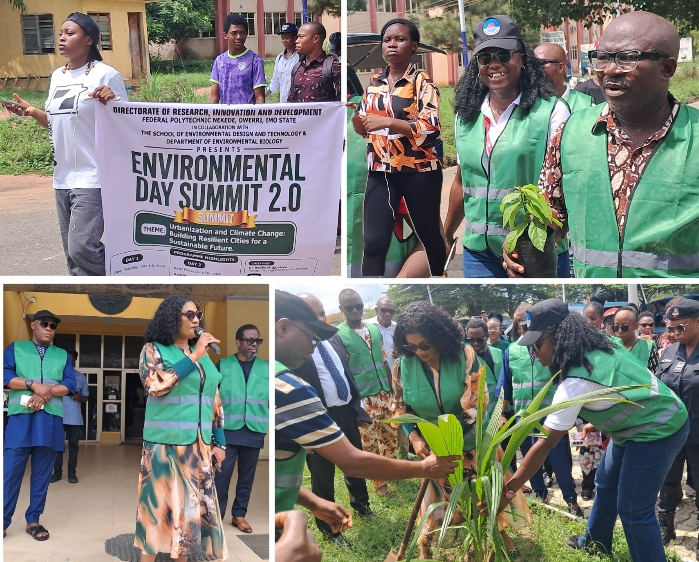
Activities commenced with a massive campus-wide tree-planting exercise that transformed the Polytechnic into a living symbol of environmental responsibility and climate consciousness.
The exercise involved the planting of both shade and economic trees across strategic locations within the institution. Beginning at the Centre of Excellence, participants moved through the Bursary Department, Evening Programme Block, Confucius Institute, School of Engineering Technology, School of Agriculture and Agricultural Technology, School of Environmental Design and Technology, School of Business and Management Technology, School of General Studies, School of Health and Related Technology, School of Information and Communication Technology, the Registry and several other locations across the campus.

The initiative was designed not only to beautify the environment but also to provide long-term ecological and economic benefits through improved air quality, erosion control, carbon sequestration, biodiversity preservation and future fruit production.
The exercise eventually culminated at the Rectory where the Rector of Federal Polytechnic Nekede, Dr. Mrs. Basilia Nkemdilim Igbokwe , officially flagged off the institutional tree-planting initiative by planting a symbolic tree alongside members of the Polytechnic Management.

Rector planting tree
Beyond environmental conservation, the exercise encouraged physical fitness and community engagement as participants moved from one location to another while creating awareness about the importance of preserving nature.
The significance of the event attracted the attention of the Nigerian Television Authority (NTA) and several other media organizations that were on ground to cover the exercise and engage the Rector on the institution’s environmental sustainability agenda.

Responding to questions from journalists on why the Polytechnic chose to commence the summit with tree planting, Dr. Igbokwe explained that climate action requires practical demonstrations.
According to her, “Environmental sustainability must go beyond conferences and conversations. We wanted to demonstrate that meaningful environmental change begins with action. Every tree planted today contributes to combating climate change, improving air quality and creating a healthier environment for future generations.”

Asked why both shade and economic trees were selected, the Rector noted that the institution deliberately sought a balance between immediate environmental benefits and long-term economic value.
“Shade trees help regulate temperature and improve the aesthetic quality of our environment, while economic trees provide lasting benefits through fruit production and ecological conservation. We are investing in a future that benefits both people and the environment.”
When questioned about the relevance of the initiative to the Polytechnic’s broader vision, Dr. Igbokwe emphasized that educational institutions have a responsibility to shape environmentally conscious citizens.
“Our mandate extends beyond academic excellence. We are committed to raising graduates who understand the importance of sustainability and who will become responsible leaders capable of addressing emerging environmental challenges.”
She further called on other institutions and stakeholders to embrace collective action in the fight against climate change.
“Climate change is a global challenge that demands local action. Every institution has a role to play in creating resilient communities and sustainable cities. Through initiatives like this, we are contributing our quota to environmental preservation and national development.”
The Rector also expressed optimism that students who participated in the exercise would become ambassadors of environmental conservation.
“We expect our students to carry these values beyond the campus. By participating directly in tree planting, they gain practical knowledge and appreciation for environmental stewardship.”
For many participants, the exercise was more than a ceremonial event; it was a symbolic investment in the future. Each tree planted represented hope, resilience and a commitment to sustainable living.
Day Two: Conversations, Innovation and Collective Action
Following the successful tree-planting exercise, attention shifted on the second day to the School of Engineering Technology 500-Capacity Auditorium, where experts and stakeholders gathered for thought provoking discussions on environmental sustainability and climate resilience.
The Rector, Dr. Mrs. Basilia N. Igbokwe, served as the Chief Host, while the Acting Director of Research, Innovation and Development, Dr. Peace Abana, hosted the event with other co-host.
In her opening address, Dr. Abana welcomed participants and described the summit as a platform for honest conversations about environmental challenges and the future society that humanity seeks to build.
She observed that climate change continues to manifest through rising temperatures, flooding, erosion, poor waste management and the gradual disappearance of green spaces.
According to her, the summit’s theme challenged participants to move beyond awareness and embrace practical actions capable of guaranteeing sustainable development.
“Sustainability is no longer the responsibility of environmental experts alone. It concerns students, educators, entrepreneurs, policymakers and every member of society,” she stated.
Dr. Abana also appreciated the sponsors and partners of the event, including NETPRO International Limited, GTCO and Tshabron Limited, for supporting the summit.
The summit featured insightful presentations by distinguished environmental scholars and professionals.
The first resource person, Arc. Dr. Chidinma Emma-Ochu, Dean of the School of Environmental Design and Technology, delivered a paper titled ” Infrastructure: Emphasising Sustainable Urban Planning.”
She highlighted the importance of strategic planning, sustainable infrastructure and environmental consciousness in developing cities capable of withstanding climate-related challenges.
The second presentation was delivered by Dr. Howard Ibogoni Clinton , former Dean of Industrial and Applied (SIAS), on ” Climate Change in the Niger Delta of Nigeria: Causes, Impacts and Mitigation Strategies.”
He examined the environmental realities confronting the Niger Delta and proposed practical approaches for mitigating climate-related impacts.
One of the most memorable moments of the summit was the symbolic tree unveiling ceremony organized by the Department of Environmental Biology under the leadership of its President, Akpan Blessing Monday.
The students presented a specially prepared tree bearing different fruits and invited deans, heads of departments, resource persons and guests to unveil the tree and partake of its fruits. The ceremony symbolized the rewards of environmental conservation and the benefits that come from nurturing nature.
The summit also provided a platform for intellectual competition among students through an essay writing contest centred on the summit’s theme.
Thirty students participated in the competition, with the top five contestants advancing to the pitching stage after a rigorous assessment process.
At the end of the competition, Miss Samuel Ebere Elizabeth , a student of Agricultural Technology and Extension Management, emerged as the overall winner and received a cash prize of One Hundred Thousand Naira sponsored by NETPRO International Limited. Other finalists were equally recognized and rewarded for their outstanding performances.
Most participating schools were rewarded with cash award and School of Environment and Design Technology (SEDT) took the 1st prize of #25,000 as the highest represented School.
Speaking during the closing session, The Organizing Committee Chairman of the event, Engr. Eneh Gerald made an appreciative closing remarks for all the support his committee received to deliver in shortest time while the Head of Department of Social Science, Dr. Paul Ikpe, commended the organizers for delivering a successful and impactful programme in his vote of thanks.
He described the summit as timely, insightful and solution driven, noting that the recommendations arising from the discussions would contribute significantly to environmental awareness and sustainable development efforts.
As the curtains fell on the two-day event, participants departed with renewed determination to contribute towards environmental preservation and climate resilience.
From planting trees across the campus landscape to engaging in robust discussions on sustainable urban development, Federal Polytechnic Nekede’s World Environment Day Summit 2.0 successfully translated environmental advocacy into meaningful action.
The event reaffirmed the institution’s position as a forward looking academic community committed to promoting sustainability, fostering innovation and building resilient cities capable of meeting the environmental challenges of the future.
Indeed, by planting trees on the first day and planting ideas on the second, Federal Polytechnic Nekede demonstrated that the journey towards a sustainable future begins with deliberate action, collective responsibility and visionary leadership.
SHARE WITH YOUR BROTHERS, SISTERS & NEIGHBOURS!!!

Discover more from NEWS CORNER
Subscribe to get the latest posts sent to your email.
About author

You might also like

Anthony Joshua Meets With Cristiano Ronaldo In Dubai Ahead of His Fight
Share on WhatsApp Two sporting goats in the form of World Heavyweight Champion Anthony Joshua and Juventus superstar Cristiano Ronaldo have just linked up out in Dubai. Ronaldo, who
SHARE WITH YOUR BROTHERS, SISTERS & NEIGHBOURS!!!


PDP Decries ‘Freezing Of Peter Obi’s Accounts’
Share on WhatsApp The Peoples Democratic Party Presidential Campaign Organisation has condemned what it says is the stoppage of transactions on all accounts belonging to the party’s Vice-Presidential candidate, Mr
SHARE WITH YOUR BROTHERS, SISTERS & NEIGHBOURS!!!


Nigeria @60: Southern YOWICAN Chairman Charges Nigerians To Always Think Nigeria First, Contribute Their Quota For a Better Society
Share on WhatsApp By Samuel Ukwu. Nigerians are charged to always be their brothers keepers as well as exhibit acts of patriotism in all their dealings with one another across
SHARE WITH YOUR BROTHERS, SISTERS & NEIGHBOURS!!!


Imo SDP Decries Killings, Destruction at Eke Ututu Market
Share on WhatsApp The leadership and members of the Social Democratic Party, SDP in Imo State said their attention has been drawn to the “gruesome and mindless killings and destruction
SHARE WITH YOUR BROTHERS, SISTERS & NEIGHBOURS!!!


Sanwo-Olu calls for collaboration between police, Lagosians.
Share on WhatsApp The Governor of Lagos State, Babajide Sanwo-Olu, on Monday called for the collaboration between the Nigerian Police and citizens of the state. Sanwo-Olu made this at the
SHARE WITH YOUR BROTHERS, SISTERS & NEIGHBOURS!!!

Easter: Group offers free medication to 270 indigent persons in Imo community
Share on WhatsApp The Gospel Generals International, a group of Christian preachers, has offered free medical services to over 270 indigent persons in Naze, Owerri North council area of Imo,


0 Comments
No Comments Yet!
You can be first to comment this post!