
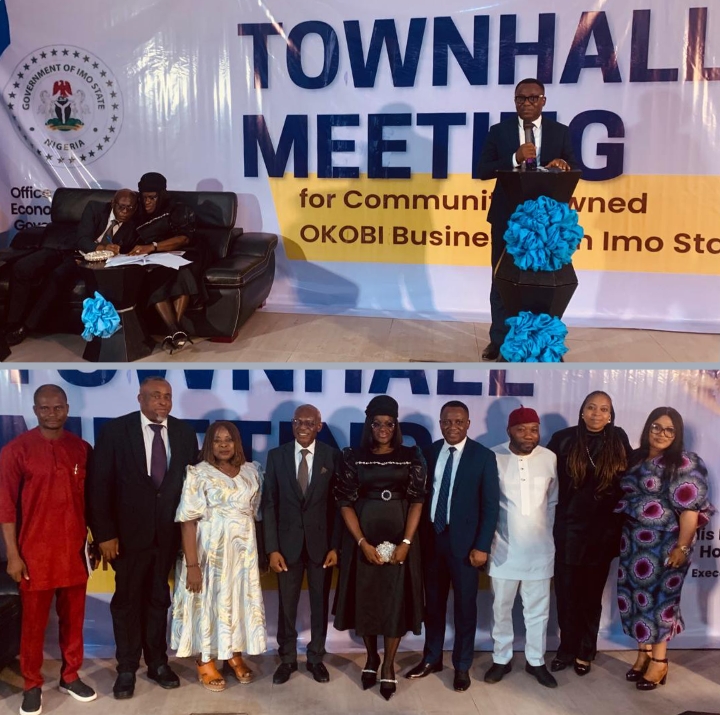
100 Imo communities get OKOBI startup backing as Uzodimma reiterates commitment
Gov. Hope Uzodimma of Imo has reiterated his administration’s commitment to sustainable economic growth through the empowerment of local communities across the state.
Uzodimma stated this on Tuesday in Owerri during a Town Hall meeting for the Community-Owned One Kindred, One Business Initiative (OKOBI) businesses in the state.
The governor, who was represented at the event by his deputy, Dr. Chinyere Ekomaru, disclosed that 65 community-owned businesses across the state have been established and are currently awaiting formal registration with the Corporate Affairs Commission (CAC).

According to him, the OKOBI initiative relies on the Igbo philosophy of Igwebuike (strength in unity) to encourage collective enterprise and wealth creation at the grassroots level.
“When kindreds pool their collective strengths, resources and talents, and take ownership of an enterprise, they can achieve far more than any one individual,” Uzodimma said.
He noted that sustainable development must complement infrastructural growth by providing viable economic opportunities for citizens within their local communities.
The governor emphasised that business incorporation was only an initial step, calling for strong governance structures to ensure long-term enterprise survival.
“Incorporation is only the beginning, not the destination. The critical question before us now is sustainability,” he said.
Uzodimma charged community managers to run the enterprises professionally and transparently to enable them to compete effectively in the market.
He assured stakeholders that the state government would continue to provide an enabling environment through supportive policies and strategic linkages with financial institutions and private sector partners.
The governor added that the success of the initiative would ultimately be determined by its overall impact on rural livelihoods.
“Success will not be measured merely by registered businesses, but by jobs created, families lifted out of poverty, and communities transformed,” he added.
Meanwhile, the immediate past state Chairman of the All Progressives Congress, Dr MacDonald Ebere, pledged to sponsor 100 communities to establish OKOBI enterprises while calling on corporate bodies and financial institutions to provide vital backing.
Ebere urged commercial banks, corporate organisations, and private investors to step in with necessary financial backing, market linkages, and technical support to sustain community-owned enterprises.
He emphasised that while government provides the foundational policy structure, the long-term survival of the businesses depends on active private sector participation.
“I call on stakeholders, financial institutions, and development partners to invest in these community-owned businesses to transform local enterprises into engines of prosperity,” Ebere said.
“I am volunteering to personally sponsor 100 additional communities to start their own OKOBI businesses so our people can generate employment and wealth,” Ebere said.
Earlier, the Chief Economic Adviser to the Imo Government, Prof. Kenneth Amaeshi, reiterated that the Federal Government had adopted the OKOBI, an Imo economic model, as a national strategy to tackle youth unemployment.

Amaeshi explained that OKOBI transitions informal local ventures into group-owned, profit-driven, and registered corporate entities capable of driving economic growth.
“OKOBI serves as a platform to convert various local skills, such as poultry, piggery, and palm oil production, into viable commercial enterprises,” Amaeshi said.
He noted that out of 656 autonomous communities in the state, 120 had earlier expressed interest, with 65 successfully advancing from basic concepts to formal business proposals.
According to him, the model incorporates rigorous data collection and professional record-keeping to enable rural entrepreneurs to access formal credit from commercial banks.
The initiative complements the state’s broader employment strategy, which includes digital skills acquisition for 300, 000 youths to stimulate job creation across various sectors.
Amaeshi further revealed that the programme had gained significant international traction, attracting interest from institutions such as the London School of Economics and investors in Bangladesh.
He added that a prominent American firm had already screened 10 local OKOBI businesses for direct foreign investment opportunities.
“Strategic partnerships have also emerged locally, with corporate entities like IHS and religious bodies, including the Anglican Communion, integrating the model into their social impact programmes.
“The Anglican Communion alone has committed to establishing 1, 500 OKOBI enterprises across its parishes through dedicated coordinators,” the economic adviser said.
Amaeshi emphasised that the initiative relies on collaborative channels, commercial viability, and institutional partnerships rather than direct government financial handouts.
Also speaking, the Director-General of the State Investment Promotion Agency, Dr Jude Nzeako, said government expanded OKOBI to rural communities to boost local production, drive exports, and ensure food security state-wide.
On her part, the Commissioner for Entrepreneurship, Skill Acquisition, and Social Responsibility, Prof. Chinonye Love-Moses, pledged full ministry support for the OKOBI initiative, describing enterprise creation as “essential to preventing poverty.”
The state Commissioner for Finance, Dr Chuck Chukwuemeka, said “government is establishing financial frameworks to provide targeted loan extensions to participants through commercial banking channels.”
Chukwuemeka said existing businesses under the OKOBI programme will receive priority access to the credit facilities as the model expands to all 654 autonomous communities in the state.
In their separate remarks, Mr Petrus Ukachukwu from Abia-Omuma community, Dr Chris Chikezie from Ndegwu community, and Chief Emmanuel Oji from Ife community, among others, all praised Uzodimma’s vision of OKOBI.
They acknowledged that government alone could not provide the necessary support needed to grow businesses but appealed to Uzodimma to fast tack their business registration with CAC and provide financial assistance to empower their community enterprises.
The 65 participating communities ventured into various businesses including fish and livestock farming, shoe making, poultry, piggery, and palm oil and timber mills.
They are also into vegetable and cassava farming, renewable energy, cassava processing, bakery, water factory, abattoir, palm plantation, feed mills, and honey extraction, among others.
SHARE WITH YOUR BROTHERS, SISTERS & NEIGHBOURS!!!

Discover more from NEWS CORNER
Subscribe to get the latest posts sent to your email.
Warning: count(): Parameter must be an array or an object that implements Countable in /home/mynewsco/public_html/wp-content/themes/trendyblog-theme/includes/single/post-tags-categories.php on line 7
About author

You might also like

China to Grant Tariff Exemptions on Additional U.S Goods
Share on WhatsApp China has said it will accept applications for new tariff exemptions for 696 products imported from the United States including key agricultural and energy products such as
SHARE WITH YOUR BROTHERS, SISTERS & NEIGHBOURS!!!


Dubai Relaxes Flight Protocol For Nigerians
Share on WhatsApp Restrictions on direct flights between Nigeria and the United Arab Emirates have been lifted after a long-standing disagreement between both countries. The dispute was over the use
SHARE WITH YOUR BROTHERS, SISTERS & NEIGHBOURS!!!


Pentagon Scraps $10 Billion Cloud Contract Amid Amazon-Microsoft Rift
Share on WhatsApp The Pentagon said Tuesday it scrapped a massive $10 billion cloud computing contract, sidestepping a bitter dispute between Amazon and Microsoft over allegations of political bias that
SHARE WITH YOUR BROTHERS, SISTERS & NEIGHBOURS!!!


Imo SWAN Endorses Owerri Preprenwa Trade Fair as Member Iheanacho Leads Vibrant December Event
Share on WhatsApp The Sports Writers Association of Nigeria (SWAN), Imo State Chapter, proudly announces its partnership and support for the Owerri Preprenwa Trade Fair, scheduled to hold from 11th
SHARE WITH YOUR BROTHERS, SISTERS & NEIGHBOURS!!!

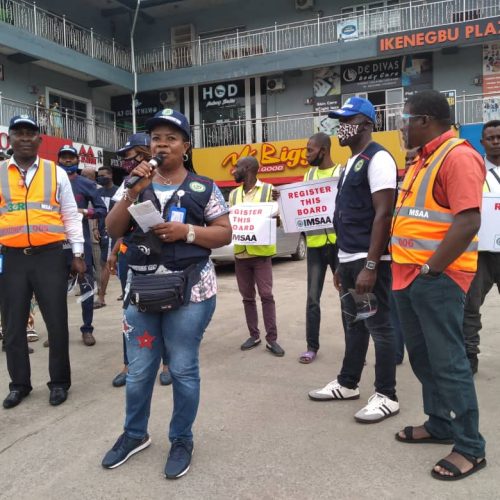
IMSAA Calls For Proper Registration, Placement of Bill Boards in Imo
Share on WhatsApp Imo State Signage and Advertisement Agency (IMSAA) has called on banks, churches, hotels, private and public organisations to ensure they clear from and register with the agency
SHARE WITH YOUR BROTHERS, SISTERS & NEIGHBOURS!!!


Facebook’s Zuckerberg wants ‘new framework’ for digital tax
Share on WhatsApp Facebook founder and CEO Mark Zuckerberg on Friday backed moves by the OECD group of free-market economies to reform the way online giants are taxed worldwide, even


0 Comments
No Comments Yet!
You can be first to comment this post!