
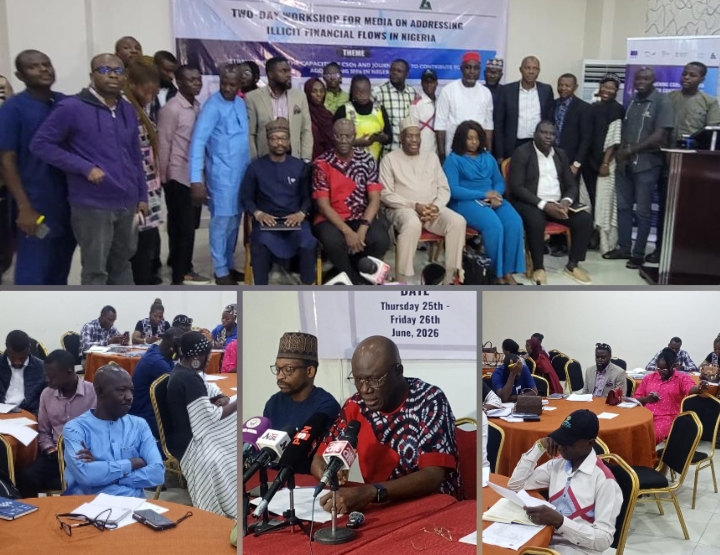
ANEEJ Interfaces with Journalists to Strengthen Reporting on Illicit Financial Flows in Nigeria
Journalists in Nigeria have been urged to strengthen investigative reporting and play a more active role in exposing illicit financial flows (IFFs), corruption, procurement abuses and financial crimes that continue to undermine the country’s economic growth and democratic governance.
The call was made during a two-day media workshop organised by the Africa Network for Environment and Economic Justice (ANEEJ) in Garki II, Abuja, with the theme, “Strengthening CSOs and Media Capacity to Contribute to the Fight Against Illicit Financial Flows in Nigeria.”

Illicit Financial Flows remain one of the greatest threats to Nigeria’s economic development, democratic governance and social justice. The phenomenon occurs through corruption, tax evasion and avoidance, trade mis-invoicing, money laundering and other illegal financial practices that deprive the nation of billions of naira annually.
Participants at the workshop were charged to uncover hidden financial crimes, expose procurement irregularities, trace suspicious money trails, interrogate official claims, amplify citizens’ concerns and demand accountability from both public and private institutions.

Speaking during his welcome address, Deputy Director of ANEEJ, Mr. Leo Atakpu, noted that Nigeria possesses several legal, policy and institutional frameworks designed to tackle corruption, money laundering, terrorist financing, procurement fraud and asset recovery.

According to him, institutions such as the Economic and Financial Crimes Commission (EFCC), the Independent Corrupt Practices and Other Related Offences Commission (ICPC), and the Nigerian Financial Intelligence Unit (NFIU) have been established to combat financial crimes, but stronger public scrutiny, responsible journalism, evidence-based reporting and informed citizen engagement remain essential.
Mr. Atakpu explained that the workshop was designed to support journalists willing to ask difficult questions, investigate complex financial issues, simplify technical information for citizens and hold those in positions of authority accountable.
“This training is not merely a capacity-building activity but an investment in public accountability and transparency,” he said.

One of the facilitators at the workshop, former Director-General of the Inter-Governmental Action Group against Money Laundering in West Africa (GIABA) and SECFIN Africa Representative, Professor Abdullahi Shehu, delivered a presentation titled “Understanding Illicit Financial Flows and Financial Crimes in Nigeria.”

Professor Shehu identified tax evasion and trade mis-invoicing as some of the major sources of IFFs, explaining that importers and exporters often deliberately falsify the value, quantity or nature of goods on invoices to illegally transfer wealth out of the country.
He further clarified that illicit financial flows and money laundering are not the same offences.
According to him, while money laundering focuses on concealing proceeds generated from criminal activities, illicit financial flows focus on the movement of illegally earned, transferred or utilised funds.
He therefore encouraged Nigerian journalists to understand the distinction between both concepts in order to strengthen financial crime reporting and public awareness.
Also speaking during the workshop, the Editor-in-Chief and Chief Operating Officer of Premium Times, Mr. Musikilu Mojeed, urged journalists to be thorough in their investigations and ensure that their reports are backed by verifiable evidence.

He advised reporters to cultivate credible sources, protect confidential information, examine company records, track asset declarations and follow offshore financial transactions to expose how Nigeria loses substantial resources through illicit financial flows.
Presenting a paper on “Assessment of Nigeria’s Legal and Institutional Framework for Addressing Illicit Financial Flows,” former Director of the Economic and Financial Crimes Commission, Mr. Aliu Mohammed Yusuf, highlighted several challenges undermining the country’s anti-IFF efforts.
These include inadequate funding for enforcement agencies, overlapping mandates among institutions, poor inter-agency collaboration, shortage of skilled personnel, information-sharing gaps and duplication of responsibilities.
He added that activities constituting illicit financial flows extend beyond tax evasion and trade mis-invoicing to include bribery, theft, foreign exchange racketeering, dubious privatisation arrangements and payments to non-existent contractors.
Participants at the workshop expressed optimism that stronger collaboration between civil society organisations and the media would improve investigative reporting, enhance transparency and support national efforts aimed at curbing illicit financial flows in Nigeria.
SHARE WITH YOUR BROTHERS, SISTERS & NEIGHBOURS!!!

Discover more from NEWS CORNER
Subscribe to get the latest posts sent to your email.
Warning: count(): Parameter must be an array or an object that implements Countable in /home/mynewsco/public_html/wp-content/themes/trendyblog-theme/includes/single/post-tags-categories.php on line 7
About author

You might also like

When War Stories Become Scholarship: Chinaza Egere’s Path from Aba to International Genocide Research
Share on WhatsApp Chinaza Justina Egere speaks softly, but her words carry continents. From Aba, Nigeria, to Purdue University in the United States, her journey is one of memory, silence,
SHARE WITH YOUR BROTHERS, SISTERS & NEIGHBOURS!!!


WhatsApp Service Has Been Restored
Share on WhatsApp WhatsApp messaging service has been restored after the global outage. This is contained in the Status update shared by the Service Handle and confirmed in the successful
SHARE WITH YOUR BROTHERS, SISTERS & NEIGHBOURS!!!


Home News Trump seeks rapid exoneration in Senate after impeachment
Share on WhatsApp US President Donald Trump pressed his Republican allies Thursday to exert rigid control of his Senate trial and ensure a swift exoneration, a day after he was
SHARE WITH YOUR BROTHERS, SISTERS & NEIGHBOURS!!!


ooni of Ife renames IPOB to IPOBN in spirit of one Nigeria.
Share on WhatsApp The Ooni of Ife, Oba Adeyeye Ogunwusi, has renamed the proscribed Indigenous People of Biafra (IPOB) as Indigenous People of Brighter Nigeria (IPOBN), saying the youths that constitute
SHARE WITH YOUR BROTHERS, SISTERS & NEIGHBOURS!!!

71yrs Old Japanese Man Arrested for ‘making 24,000 complaint calls’
Share on WhatsApp A Japanese pensioner has been arrested after ringing a phone company 24,000 times to complain they had violated his contract, police and local media reported. Tokyo police
SHARE WITH YOUR BROTHERS, SISTERS & NEIGHBOURS!!!


Buhari assures Women & Youths of Total Inclusion in Govt
Share on WhatsApp President Muhammadu Buhari has assured women and youths of his determination to fully engage them in his second tenure, in relation to the significant role they played


0 Comments
No Comments Yet!
You can be first to comment this post!